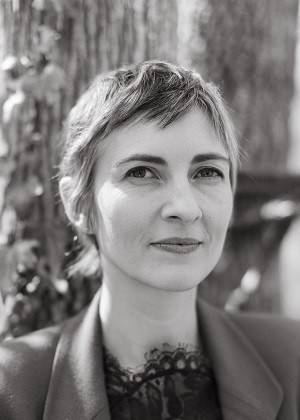
Emerging Poet Feature: Jasmine Khaliq
I love when I encounter poetry that doesn’t pretend to have it all figured out–poetry that feels legitimately curious, questioning, desiring, as opposed to offering solid representations or performances of those states of being. Poetry that nudges forward delicately, probing, like the soft and retractable tentacles of the noble snail.
Jasmine Khaliq’s poems are just this type of sensitive, tentacular poetry. The quality of their observation–whether turned outward or inward–is as fine as silk, their questions are sincere as a child’s, but their treatment of identity and social convention points to the sharp intellect, emotional maturity, and healthy defiance of expectations underlying the poems’ more whimsical surface.
I hope you enjoy my conversation with Jasmine Khaliq. In it, we discuss the slipperiness of identity, language’s ability to structure the activity of the imagination, animals and belonging, poetic influences, and what’s on the horizon for Khaliq’s work. To accompany her two poems, “I’m Wife” and “Pigeon, Doe” from Issue No. 45, she’s agreed to share two additional poems with our readers. As you read her work, give yourself over to that liminal space between the self and the other, the fog where our various identities alternately blend and coalesce.
—Sarah Rose Nordgren
 Jasmine Khaliq is the author of Somewhere Horses, winner of the Barrow Street Press Editors’ Prize, forthcoming April 2027. Her poetry is found in Best New Poets 2023, Passages North, Poet Lore, The Rumpus, and elsewhere. She holds a BA from San Francisco State University and an MFA from University of Washington, Seattle. Currently, Jasmine is a Ph.D. Candidate in English and Creative Writing at the University of Utah.
Poems:
“I’m Wife—” (from 32 Poems #45)
“Pigeon, Doe” (from 32 Poems #45)
“Aprils” (featured here)
“Belonging” (featured here)
Interview:
SRN: Jasmine, one element of your poems that first drew me in is their concern with the slipperiness of identity, and particularly the process of inhabiting female gender roles. Both of your poems in the magazine not only resonated–playfully, delicately–with aspects of my own experience of womanhood, but also with theorists such as Joan Riviere (womanliness as a masquerade), Judith Butler (gender as performance), and Laura Mulvey (male gaze). Theory aside, however, the poems dwell in both the embodied and intellectual space of living while also self-surveiling. Does this resonate with your intention, and could you say more about how you think of identity (and perhaps womanhood) in your poems?
JK: My heart is so warmed to have theory immediately invoked. Thank you for this reading and question. I’m very interested in relationships, which leads to interest in identity. I’m preoccupied with the formation of the I and the You, so much of this exploration leads to exploration of gender. The formation of my I is one with my experiences as a woman and my earlier experiences as a girl. I realized early that gender shaped every one of my interactions. That’s really the core of it—the interactions. That’s why there is, at once, a deeply embodied—stuck—experience paired with this self-surveilling gaze. That elasticity in relationships of all kinds—I make you and you make me—I’m thinking about it all the time. I’m making myself through you. I have to. So then identity is slippery, dynamic, relational, illusory. Not so much mine. Or not just mine. But it is attached to me—my being in the physical world. My experience of being a woman is wrapped up with every bit of my life, including my understanding of myself as an I/Self and my understanding of myself as someone else’s You/Other. That I am always really both, even in my formation of myself, is hard to wrap my head around.
SRN: This has me thinking about the final line of your poem “Pigeon/Doe,” “I didn’t imagine anything,” which literally stopped my breath in surprise when I first read it, especially coming so soon after the lines, “She could have had any body–/Equine, aquatic, monstrous, winged.” I’m thinking about the duality of possibility and blankness here, in this case referring to the doe whose body is obscured by fog. There are a number of dynamics at work–has the speaker’s performativity stunted her imagination and she’s become so focused on the surface of things that she can no longer perceive what lies beneath the proverbial fog? On the other hand, the speaker does imagine what could lie beneath–it’s her voice that tells us what kinds of bodies the doe could have. So there’s a contradiction there in what the speaker imagines and what she tells us that she imagines. There’s also, for me, an acknowledgement inherent in the poem that the doe is an other in the sense of being ultimately unknowable. The speaker’s lack of imagination could be a failure on her part, but it can also arise from a respect for the deer, an acknowledgement–based on her own experience of the gaps between the public and private self–that the doe is also a being unto herself and not subject to the speaker’s imagination.
JK: Thank you for such a deep reading—I love to see the phrase “a number of dynamics,” that’s what I’m always hoping for in my poetry. That last point about the doe’s being ultimately unknowable is important to me. I want that to be clear, and I think the respect and understanding that that acknowledgement can create is really beautiful. I think about that later contradiction of imagination as possibly having to do with time and distance from the moment, too, or really the possibilities that language presents in its ability to pull in associations and activate the imagination as it puts words to an experience. So, yes, there’s hopefully always a number of dynamics—identity is made and understood only within relation to our past and present experiences, other people, the world…it is constantly becoming. There is constant tension in that process, especially in that gap between being an I and realizing there is a public You that is different to and for everyone. I like to think into all of this; it definitely has something to do with how many animals end up in my poems. The animals are in my life, too! But there is so much of my life that doesn’t make it into poems. The animals make it in. Deer, cows, horses, rabbits, dogs, birds, bats, bees, cats, flies, moose, fish, pigs, roosters, foxes, sheep…
SRN: I’m glad to hear that the animals are in your life too, and not just the poems. I like to think I can tell when the animals in a poem are real animals or abstracted ones! Perhaps “Belonging” is an interesting companion to “Pigeon, Doe” because in that poem it seems more as if the speaker herself feels like the other in her inability to achieve the kind of natural, bodily closeness that comes easily to the bats. She is the strange one, the complicated and unknowable one, while the bats seem to have life figured out.
On another note, can you share some of your poetic influences? I appreciate your poems’ senses of delicacy, wonder, and curiosity which reminds me of Jean Valentine, but I’d love to hear about who you consider to be your most prominent poetry foreparents.
JK: I love Jean Valentine, thank you! She’s been a large influence on me. Her poems feel like secrets; that thrills me. Emily Dickinson, C.D. Wright, Lucille Clifton, Louise Glück, Sylvia Plath, Kim Hyesoon, Marina Tsvetaeva, Gerard Manley Hopkins, and Lucie Brock-Broido have all done so much to shape me and my work, too. I think I’ll be obsessed with Emily Dickinson until I die. Her poetry astonishes me endlessly. The title of “I’m Wife—” is a nod to a poem of hers I’ve always loved ( “I’m ‘wife’ – I’ve finished that –“ ). I almost hate giving titles to my poems. I can never begin with them. Sometimes it takes months after a poem is finished for a title to appear to me. This sonnet sat untitled for a long time; eventually I realized I should look to Dickinson. I love her lack of titles.
SRN: Yes! I picked up on the Dickinson-inspired title (that dash!), so I’m glad you brought that up, and that’s a wonderfully and auspicious line up of influences you have there (many of whom are in my personal poetic pantheon as well). In closing, is there anything you’d like to share with us about what you’re working on right now, or what’s on the horizon for you and your writing?
JK: Right now, I’m working on my second manuscript. I’m very excited about it. It’ll also be my dissertation when I finish up my PhD here at the University of Utah. “Pigeon, Doe” and “I’m Wife—” are both from this new manuscript, which is of course concerned with relationships, formation of the self, reading, influence, interpretation, performance…it’s a very intertextual manuscript. There’s a lot of dreams, I can’t seem to help that. Also, my debut collection, Somewhere Horses, is forthcoming April 2027 with Barrow Street Press! That doesn’t feel quite real yet. I am so excited to see that book enter the world. So excited to hold it at the Chicago AWP. I’m just really grateful to everyone who has had a hand in shaping me and that book and all its pining-horse-cow-childhood-California poetry. I’ll end on that, I think: thank you to anyone who has ever read a poem of mine, inspired a poem of mine, or influenced a poem of mine…and thank you, Sarah Rose, and 32 Poems for this lovely and generous spotlight.