Across Such an Octave: An Interview with Danusha Laméris by Cate Lycurgus

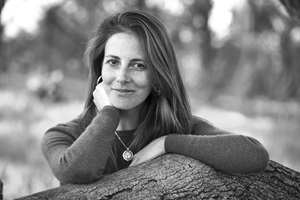
Danusha Laméris is an American poet, raised in Northern California, born to a Dutch father and Barbadian mother. Her first book, The Moons of August (Autumn House, 2014), was chosen by Naomi Shihab Nye as the winner of the Autumn House Press Poetry Prize and was a finalist for the Milt Kessler Award. Her second collection, Bonfire Opera, (University of Pittsburgh Press, Pitt Poetry Series, 2020), won the 2021 Northern California Book Award in Poetry and was a finalist for the 2021 Paterson Poetry Award. Her third and newest collection, Blade by Blade (Copper Canyon Press), was published in 2024. Her work has been published in Best American Poetry, The New York Times, American Poetry Review, Gettysburg Review, Prairie Schooner, Ploughshares, and Orion. The recipient of the 2020 Lucille Clifton Legacy Award, Danusha has taught poetry independently since 2006. She founded The Hive Poetry Collective, a radio show, podcast, and event hub in Santa Cruz, CA, where she was the 2018-2020 Poet Laureate. She is currently at work on a collection of nature essays.
Cate Lycurgus, Interviews Editor: There are so many places we could begin, but if I were asked to describe your work in one word, I would say ‘lush.’ And increasingly so as collections progress, though not always in terms of subject but also through language and the way its sensuality leads us to ever-more fecund emotional territory.
I think of the cows with their “tongues torqued sideways,” cows who will eventually become supper; or an iris petal slipped between the speaker’s breasts during sex as “a kind of bookmark” for an ended relationship; or a child’s ashes in her purse like a “compact,/ dust to tint the cheeks.” Striking as so many of your images are, they are never sensation for sensation’s sake, but keys to a more spacious humanity. So to begin, I’m wondering if you can share how an image or sensation makes its way into your pieces? How do you move from observation to poem, and especially without cliché? What role does place play?
Danusha Laméris: Well, first of all, thank you for introducing the word ‘lush’ into the conversation. A quick synonym search brings me: voluptuous, opulent, riotous, abundant, plush, green. Yes to all of the above! As a culture, I think we fear the sensuous, when so often it’s what saves us by offering us a connection to the natural world of which we are a part. So many of my peak experiences have involved berries, blossoms, and birds. These delight in the best of times––but illuminate in the worst.
In terms of the path from observation to poem, I find it hard to trace. Probably the most important step is living in a way that we feel, touch, experience. I believe my poems can be better than I am (as Lucille Clifton put it) but not more full than my lived experience. Naomi Shihab Nye says, “Your life is the poem.” Our first task is to live.
CL: This reminder—that our poems are deeply reflective of our living—reminds me too of something Stanley Kunitz wrote in an introduction to his later work, “Does one live, therefore, for the sake of poetry? No, the reverse is true: poetry is for the sake of the life.” I know for me, it’s a way of moving mindfully, as in paying close attention, as in tending, with care. Like you mention, you (and therefore your poems) are so attentive to certain creatures and the way we are in communion.
Early in your latest collection, Blade by Blade, there’s a poem, “Slither,” where the speaker describes her childhood familiarity with all types of reptiles; now though, when catching a toad, her shriek makes it clear she’d “become a stranger to the world,” that she no longer was “the girl who’d eat snails straight from the garden, / pluck them from the beds of tulips, put them in her mouth, / chew the wet flesh, the crunchy shell.” I startled at that immediacy and brutality. That same poem ends with a wish to “slip back into her small body…when I was small as the curve / of a spoon, hidden in the body of my mother, slick and gilled— / ready to begin again. To enter the realm I’d know by its / soft loam, dark water, rough dirt.” There’s tension here between familiarity and the un-familiarity which grabs our attention, jolts us, perhaps lets us begin again. How do you think about making things strange or new in your poems? What possibilities of poems let the ordinary shimmer into extra-ordinary?
DL: There’s a thing about wonder and surprise that surprises me: We tend to think of wonder as a gift of childhood, but life only bewilders and surprises me more over time. The other day my dog wandered out onto the deck and came back with a tiny universe on her nose. A cluster of moss, I believe, with little raised bits that looked like flowers from a Dr. Seuss children’s book. Right now it’s raining and the smell of the rain coming through my window carries a lifetime of memories. I’m in first grade again, stomping in mud puddles. I’m a girl walking through the redwoods with my arm around a deer. I’m a woman, soaked and running through a thunderstorm somewhere in Texas. There’s a muchness to life that layers over itself with time and makes strangeness ever-possible. Once I thought my laundry was singing to me when I took it from the line, but it was a beetle. Every time I shook the sheets, it let out a funny little cry.
All this to say, we don’t have to look far for the odd, the wonderful, the frightening, the extra-ordinary. It is there waiting for us to notice. Rilke said, in his Ninth Duino Elegy, that perhaps we’re here so we can name things and allow them to exist more deeply by speaking them into being: “to say: house, bridge, fountain, gate, pitcher, fruit-tree, window–at most: column, tower. . . .” I love the idea that there is urgency and meaning that comes from giving language to the world as it is.
CL: I love this. Continual wonder is more than déjà vu, and I think bewilderment is part of it, how the same thing can return but stranger, stranger maybe because what we thought was once, or lost, once again loops back. There are so many things that recur in your poems—horses or car rides or fruits of all kinds—yet continue to surprise. Or sometimes it’s a reckoning or a grief that won’t go. I’m thinking of the poem “Remodeling” in your first book where a brother remodels a bathroom the summer of his suicide, how “each day, he’d kneel down / to the task, / the wiring of his brain / whisking loose.” The poem continues when “sunlight pours into that room / sounds its dull echo / off porcelain and chrome. // He’d become a stranger to us.” Strange then, in Bonfire Opera’s “The Cat,” how the brother comes back as a cat Rocky, also unrecognizable. This inability to recognize signs returns later in one of my favorite pieces “Blue Note,” where the speaker describes caring for her brother’s houseplants, all named after jazz musicians, how “sometimes the leaves start to yellow and you don’t even notice. / There’s a sound absence makes, even before it arrives, / a static in the ether, high and blue and held.” Making sense of this loss is unending. For me, I know I will never be done with the ocean or nectarines, light in all of its iterations, will never be over my dad or what a lifetime of caregiving has made of me. So many things are waiting for us to notice, and so many things we can’t stop noticing, can’t stop holding up. Can you share more about the impulse to name or relay things again and again? Or the importance of continuing to do so, continuing to speak into being? When something loops back, how do you avoid the trap of what was, and language the world that is?
DL: I love the way this question enacts itself: It, too, loops back, regathers, considers strangeness, impulse, grief. This is what a good life is made of. Considering, then considering again. I used to think twenty years of experience in anything was a lot, enough for mastery, whether that be meditation, painting, or marriage. Now I know we are all novices. I think of Jiro, the chef in the documentary Jiro Dreams of Sushi, who has his apprentices spend up to ten years focused on making rice.
We imagine a lifetime is enough to change completely in every capacity, but, in fact, we spend more of our lives prone to the same weaknesses, the same obsessions, and even the same recurring nouns. Your mentions: ocean, nectarine, father. We repeat, too, the same lessons, becoming, perhaps, slightly wiser at each pass.
One of the great gifts we can give ourselves as writers is to accept the stories and images that recur in our work, to honor them and to make space for them. And, at the same time, to make room for ourselves, and our own repetitions. Otherwise, we are not allowing ourselves to show up to the page, and to our lives, as we are. We must spend some years cooking rice. And then, cook more rice. Students often ask me about whether I wait to be inspired to write and I say no. It’s not that I try to force myself to the page, but rather that I spend time reading and living and then, inevitably, feel like writing. I love how a body of work serves as a record of our return.
CL: How incredible, years learning to make rice. Not to minimize rice, but if it takes years for rice, it might take a lifetime to get a poem down, several lifetimes to learn low to love. Though at risk of sounding too much Octavia Butler, I don’t know that we can master anything, when change is our master, and more often than not we’re novices again. Which requires a certain sense of humility, as does accepting what comes and embracing it. Honestly, when I’m writing my best work, the words are not mine. It sounds hokey, but it’s like I’m channeling something beyond me, something I’ve been practicing to be able to hear and ferry forth. Yet there’s that temptation and etymology, too, to think of our role as poets as these singular makers, creators. I’m reminded of your piece “Fictional Characters” where the speaker wonders if Holden Caulfield, Anna Karenina, even Hector, get tired of their sagas, of being scripted by their authors. The poem continues “Wouldn’t you, if you could? / Step out of your own story, / to lean against a doorway / of the Five & Dime, sipping your coffee, // your life, somewhere far behind you, / all its heat and toil nothing but a tale / resting in the hands of a stranger, / the sidewalk ahead wet and glistening.”
To what degree do you “step out of your own story” when writing? Or given that your work is so bodily, is it even possible to? Desirable? Do you think of poems as fictions or artifice, or as artifacts of practice?
DL: Again, I love your question. Artifact or Artifice? I think it’s a combination of the two: part authentic expression of an event or awareness, part something else. I took a choreography class in college and the teacher asked us the difference between performance and dancing in our own living room. She didn’t answer the question, but left us with a koan. I don’t think, as poets, we should assume we deserve the reader’s attention. I mean, we all deserve to be heard in a larger sense, but I like to remember my reader is busy. There are dishes to wash, kids to pick up, plants to tend, never mind a million things to watch on YouTube. I want the poem to give them a worthwhile place to dwell for the moment it takes to read it.
As a reader, I want so many things. I want to feel an impossibility of beauty paired with a boundless sorrow. I want those things to be almost exactly transposed over each other so that I recognize them as life as I have known it. And then I want whatever I’m reading to be funny or entertaining, and preferably, odd. And then, and then…we are such demanding creatures! Craft allows us authenticity as well as artifice. I started out studying painting and so I am aware that first you learn to draw, and then you play with color. Only, all the while, you are, as you (and Octavia) say, a novice. Being a novice is a brilliant thing because you are on a journey with no arrival, only travel by water, earth, and air. And ink.
Writing allows me to always live on the edge of discomfort, which is a gift. I know and don’t know what I’m doing. I know and don’t know what I might be about to say. I am not necessarily at ease with the end result. I am, for example, a private person who shares her life in public. I am revisiting my life in ways that cast and recast in it different lights. Whose story is it? It’s mine. It belongs, equally, to the wind.
CL: To the breath that holds the dust of me up. And what can I say that the wind hasn’t, better? Yet we do owe it, I think, to our current arrangement of dust to bring forth whatever can come through this particular iteration of being. For me, the idea of being a conduit for transformation is both uncomfortable and the only way to persist, like you write in “What Trees Dream Of”:
…when we die,
they meet us in the blackened soil
and take us back
carry us
up the length of their bodies
into the trembling leaves.
So much of the artifice seems to be in how we try to make or say something given our finitude, even when, as you write in “The Grass,” “goodness is taken, mercilessly, back.” That poem, in conversation with Whitman and a brother lost to suicide, asks “What is the grass? / It is what covers his body, and is composed of his body…so I think I can say, now, / that the grass is my brother.” Uncomfortability redefines the relationship, and ends with direct address:
…Dear Grass, Dear
Curling Fronds, Dear Little Twists of Green, it’s me, your sister.
I do not blame you. I only want to sit with you and stroke your windy hair.
Which is so lovely, and so hard to bear. And also brings me back to what you said about the gift of readers’ attention and not taking it for granted. There’s a fine line though between keeping readers in mind, and writing to please a particular audience (or market). I think about that a lot, what I’m offering and to whom, and to avoid the latter, often do think of poems as letters meant for a particular dear heart or entity. Or to counteract the radio silence of oblivion. Do you think of particular readers when you write, or have an ideal reader in mind?
DL: I find myself drawn to poems of direct address. There’s an intimacy they offer the reader that mimics overheard conversation. It’s one of life’s enjoyments to catch a glimpse of a story, even if we don’t know the full heft of it. And part of that is due to the fact that it’s not our story, doesn’t carry our exact concerns, even if they rhyme with ours. That said, I don’t know that I write that many poems of direct address! I have moments, such as the one you cited in “The Grass.” Sometimes, in writing a poem, you find yourself in a corner with no one to turn to but the dead. Or God. Or trees. When I find myself in such a place, I speak to that intended.
I love what you say about being indebted to “our current arrangement of dust.” What a wonderful thought! Yes, we are this person only for a while and want to offer whatever we can in the current iteration. Or rather, to offer the truest expression we are able, to whomever might receive it. Once I met a woman who sang to whales from a boat and the whales gathered to listen. Now that’s quite the intended audience! It’s impossible to know where and how our poems will land and with whom. I don’t try to guess. I assume that whoever they are, they have suffered and held hope. Have been hungry and been fed. Have had desires that have fallen in their hands, and others that have eluded them no matter how hard they tried. The world is a series of events that play out, repeat. And our job, as far as I can tell, is to keep arriving in that story, perpetual as it is, willing, engaged, and anew.
CL: As an intensely sonic poet who often works with slant rhyme and assonance, I remember being blown away hearing Matthew Zapruder speak about “conceptual rhymes” and the possibilities they afford. And now, can’t stop thinking how the world would change if we thought about our stories as rhyming—not the same, but with shared echoes, kindred but not twin. So often (in writing and life) I think we’re trained to notice like/unlike, point out synonym and antonym. But a rhyming story requires attention, engagement, nuance.
I’m thinking of your piece “Palm Trees” in which the speaker has a flat tire and a stranger at the truck stop, also Caribbean, draws her a crude picture of palm trees, much as a child would. Whether of origin, circumstance, or the impulse toward offering, the stories of these two rhyme. It’s a bizarre encounter to relate and yet in the poem we read “how easily we miss it—that opening / into ceremony.” When I think of ceremony, I think of something planned and formal, and yet this is a spontaneous occasion; in many poems the speaker seems to arrive serendipitously upon something sacred. How do you think about ceremony in poems, either with content like “Palm Trees” or through the tacit meeting of reader and writer on the page? How also does this manifest itself in the (even if not ‘formal’) forms your poems take?
DL: Well, I think about the poems themselves as rituals. The writing of them, and the event of reading them, or listening to them read aloud. A ritual has certain elements: It arrests our attention, offers the promise of transformation, invokes, in some way, the act of breaking something, and is limited in time. Think of a wedding ceremony. It easily lives up to the above, with the breaking being the cutting of the cake or stomping on a glass. Think of the way kids become blood brothers/sisters by cutting their thumbs and mixing their blood so they’ll be connected forever. A good poem, one that has meaning for us, offers us all of the above by introducing brokenness: line breaks, broken syntax, images of what is rusted, bent, frayed. It keeps our attention and offers the possibility of small but true change. The poems I love most have altered my perception in an ongoing way. I think often of this Emily Brontë quote:
“I’ve dreamt in my life dreams that have stayed with me ever after, and changed my ideas: they’ve gone through and through me, like wine through water, and altered the colour of my mind.”
This is true of me with poems. Whether they’re ones I’ve written, or ones I’ve read. Writing that palm tree poem allowed me to reenter the event it describes, slow time, and experience what now seems to be a sacred exchange. Something I had, in the flurry of the moment, missed.
CL: This is so interesting. When I think about ritual, I often think about something rote, something done habitually or without thinking, which is really counter to having that sacred exchange. Perhaps the element of breaking, of arresting, is also key to a ritual with meaning, as opposed to one that merely suspends. Or is there ‘mere’ suspension? I’m curious what you do to avoid the rote or routine in poems? And what does a ritual like that—one of fissure, pain, or dare I say, sacrifice—cost?
DL: While it’s difficult to break down what happens in the act of writing, I, like other poets, have found some fissures in the plaster that allow me to break into the house of a poem. Not always, but with luck. It has to do with finding the unfinished thing: the story that troubles you because you have never been able to make sense of it, a line or two of conversation overheard at a restaurant, a partial memory, a song to which you can’t quite remember the words. We are both made of, and disturbed by, fragments. Shards. And we know we are entering the territory of the sacred when we approach what is broken with attention. And when we are truthful, our lives are stranger than we can invent, as is life itself. So, rather than avoiding the expected or routine, we often avoid the oddities of the actual. We find the unexpected when we stop resisting what is.
As a child, I loved wading in creeks. And one of my favorite things was to pick up an underwater rock and look on the underside for a cluster of much smaller rocks that I knew housed a kind of worm. I just liked to observe it, to know this creature was there, having made its own miniature house of stone. I now know these to be caddisfly larvae, an early iteration of an insect that will one day take to the air. How miraculous that something so small can experience the world across such an octave. One end of the scope to the other. A poem is like that. A house we make of the bits of debris we have. A house we live—and change—in. It seems to me the greater cost comes, not from dwelling in our brokenness and speaking of it, but in avoiding the possibility of wholeness it can bring.
CL: And what isn’t broken, or in the process of becoming so? The brokenness evinces wholeness, since the whole contains hurt. So often I think our lens must be broken too, or incomplete—as in, we can’t fathom the whole picture, imagine the full story, and see how our dissolutions are integral, even more so for transformation. This reminds me of one of my favorite pieces in Blade By Blade, “Prayer to Be Undone.” In it the speaker says “…the universe is one rhymed thing, but I keep / wanting to rhyme I, I—to capitalize myself, stand apart from the whole. / I know I am a cloth and someday you will pull my thread, / unravel me—please unravel me—with your deft, invisible hands.” What do you see as the relationship between poetry and prayer? How (does) your concept of the divine influence your work?
DL: For me, a poem is often a kind of plea, a way of beseeching, of trying to make sense of, of reaching for what I can’t quite fathom or comprehend. In that sense, they are both a form of prayer and a kind of failure. We cannot say the unsayable. Cannot perceive the invisible. Cannot fully answer our deepest questions nor quench our deepest longings. I like to say our failure is our sacrament. We can only get so close to it—what we mean to say, what we wish to know, and what we most want.
I should say that a prayer/poem I keep returning to is Nickole Brown’s “Prayer to be Still and Know.” It’s the poem in which she says, “Prick my ears, Lord. Make them hungry / satellites, have your way with their tiny bones…” I love the raw yearning in this poem. The way the speaker is asking, nearly begging, to know the world through the sounds of woodpecker, mink, and owl. It’s a stunning poem. And one that brings me to the brink of tears every time I read it. A rare feat! We want the world. We feel the world won’t, entirely, let us in on its deepest secrets. But that doesn’t stop us from asking.
CL: We reach and get incrementally closer, but answers or adequate words would eliminate mystery and could preclude wonder, perhaps. I think of faith in a similar way—: not as any certainty or knowledge, but as a motion toward the divine. Wanting this communion or comprehension, as you mention and the Brown poem also does, might be part of the point. Which brings me to my final question—if you met someone who has had little to no (or maybe just the high-school-conventional) exposure to poetry, someone both aching from and asking for the world, what poem would you share first?
DL: Oohh! Where to start…. Poems are very specific, like homeopathic remedies. So I suppose that depends upon what ails them. And that said, most of us are troubled by the way nothing lasts, and how the heart can/can’t bear that knowing. So I feel it’s safe to prescribe Jane Hirshfield’s “For What Binds Us.” This is the poem that ends:
And when two people have loved each other
see how it is like a
scar between their bodies,
stronger, darker, and proud;
how the black cord makes of them a single fabric
that nothing can tear or mend.
So here’s to our unmendable, stronger selves that somehow endure tremendous challenge and remain curious enough to read a poem—or write one—and carry on.