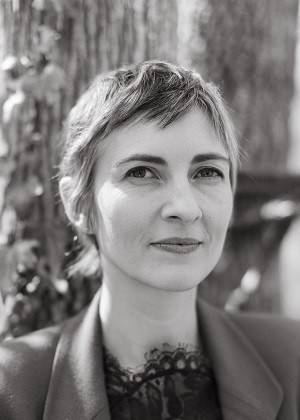
Emerging Poet Feature: Betsy Mitchell Martinez
One of the eternal challenges and, indeed, contradictions of using language as one’s artistic medium is the fact that language–especially written language–pulls us almost relentlessly into the intellect, into meaning-making and interpretation and, as a result, away from the senses and the life of the body that writers are often trying to express. Unlike other mediums–music, visual art, dance–writing can struggle to leave the territory of aboutness and enter the realm of being. This ongoing tension can make it feel all the more ecstatic, then, in the moments when poems and stories succeed in dropping us into those realms that run deeper and further than our human language extends. I had such a moment when I first read “Summer Birth Plan with Contingencies,” Betsy Mitchell Martinez’s gorgeous and disorienting poem from Issue No. 46 in which the borderland of birthgiving blends with those of extreme weather, memory, and the splitting open and reconstitution of self that accompanies new parenthood. I was also happy to encounter the new poems she’s been writing about the artist Frida Kahlo that share “Summer Birth Plan’s” reverence for physical rupture, pain, and the simultaneous fragmentation and sacredness of the unconscious. Read on for our conversation about how Kahlo’s work found its way into Martinez’s poetry, finding poetry-writing again after many years, collaborations with preschoolers, and where Martinez’s poetry may lead her next. You will also find three of these new Kahlo poems that seethe with color, pain, and symbolism like troubled and beautiful dreams.
—Sarah Rose Nordgren
 Betsy Mitchell Martinez holds an MFA from the University of Michigan. Her recent poems have appeared or are forthcoming in Beloit Poetry Journal, Gulf Coast, Rhino, Southeast Review, Shō Poetry Journal, and elsewhere.
Poems:
“Summer Birth Plan with Contingencies” (from 32 Poems #46)
“Access Point (Self Portrait with Monkey, 1940)” (featured here)
“Super Bloom (Roots, 1943)” (featured here)
“Abecedarian in White (Self-Portrait, 1948)” (featured here)
Interview:
SRN: Your poem “Summer Birth Plan with Contingencies” struck me so deeply when I first encountered it, Betsy. I think this is partly because I too gave birth during an intense summer rainstorm and ultimately gave up my efforts to “refold / that map of intermittent hours on its creases,” but mostly because of how your poem, in its images and in its waving, irregular form on the page, so magically conveys the liminality and risk–the sense of being on the edge of both destruction and creation–that accompanies birthing. Can you share a little about how this poem came to be, and how you found your way into writing about this experience?
BM: I’m so glad this poem resonated with you because it was a tough one for me to write! I didn’t set out to write a birth story at all. When I started work on the poem, I was inspired by a vivid but unrelated dream about birds. By the second stanza, though, something about the dream’s emotional landscape took me back to the monsoon that flooded our streets and yard when my now-11-year-old son was born. I try not to think about his birth much because–as with many births–it didn’t go according to plan. My memories from that time are fragmented; I mostly have flashes of chaos in the room, a sense of being at the center of a commotion without being an active participant in it. Once the monsoon entered the poem, though, it asked me to return to the hospital and sift through the fragments of memory to see what I could find there. I generally feel a bit uncomfortable when my poems get too close to a personal narrative, but it snuck up on me in this one!
SRN: The poems you’re working on now about Frida Kahlo share qualities with “Summer Birth Plan.” I notice the attention to body sensation, to the fragmentary, dreamlike image, and the desire to somehow piece together or organize the raw materials of experience. Rereading the new poems now, I also note the rain storm that opens “Abecedarian in White,” like the storm in “Summer Birth Plan,” and even the repeated image of creasing and folding, which I experience as a desire for order amidst the chaotic weather. Can you tell us a little about this new Frida Kahlo series you’re working on, including what drew you to writing about her and her work, and how you see these poems in relation to your poetry as a whole?
BM: When my daughter was in preschool a couple years ago, she became obsessed with Frida Kahlo. We read Frida books on repeat and talked about questions like: What is a wound? Why does Frida cry in her paintings? How did Frida lose her leg? My daughter even started dressing up as Frida and drawing herself with tears on her cheeks.
I hadn’t really written poems since receiving my MFA in 2006, but something about those Frida conversations kept me up at night thinking about pain and art, puzzling over the ways in which Frida speaks to so many people, even the youngest children. I started playing around with couplets in Frida’s imagined voice and remembered how much I love language that–like Frida’s paintings–moves outside of strict narrative and logic. I’ve been working on the series since that time, but it’s a slow process because the paintings don’t give up their secrets very easily. I usually think about a painting for weeks or months before I figure out a way to inhabit it.
I’m glad you mention creasing and folding, because it’s shown up as an unexpected theme in these poems (and in other non-Frida poems, too, as you point out). Frida often depicts herself in traditional clothing that features pleats, layers, and twists, and I’m interested in the way the folds and twists highlight one side of things while obscuring other sides. In a way, writing poems about the paintings feels like a study of creases–figuring out what Frida places in the foreground but also what she hides in shadow and what lives on the backside of each image.
I’m still trying to figure out how the Frida project relates to my other work. One of the things I’ve enjoyed since I started writing poetry again is using a kind of dream-logic to make emotional sense of the world. Maybe that’s the link between the different sets of poems?
SRN: That’s wonderful that Frida and your daughter collaborated to reawaken your poetry writing practice! I’m not surprised to hear that her paintings compelled you to the page. I find that one pitfall of ekphrastic poems can be that they’re unable to breach the boundary between observer and observed; there can remain a cool distance. But these feel full of the heat, pain, and ecstasy of living. There’s urgency here. Your writing in persona helps breach any potential distance between the poet and the art in question, but your poems also do a splendid job of inhabiting the physicality of the paintings. Do you think that your daughter’s interest in Frida, especially given her age at the time, influenced your pathway or approach to the poems? I’m thinking especially of how experiences like sadness, happiness, and pain–big emotions, and body-experiences–are of central concern to young children.
BM: That’s a really interesting question. The thing about 3- and 4-year olds is that they’re relentless with their questions. They’ll ask the same thing over and over for days or weeks, especially if they’re not convinced by the answers they receive.
Looking back, I remember my daughter being hyper-focused on a painting called “The Wounded Deer,” in which Frida painted her own face on the body of a deer that’s been impaled with arrows. Every day, my daughter would ask what the “wound” was. Did Frida have a wound, or just the deer? How was Frida wounded if the arrows didn’t touch her face? Is it a wound to have your face stuck on an animal’s body? Is sadness a wound? And, because these were excellent and difficult questions, I rarely had good answers. I usually responded by asking my daughter what she thought, or suggesting that she might imagine how Frida felt when creating that image. We had some great discussions, but my daughter was never satisfied by them. The following day, she would start the whole conversation again from the beginning.
I wonder now if that kind of questioning taught me how to think about Frida’s work. As you point out, my daughter was at an age when she was very aware of bodies and pain and big emotions. She wanted to understand all the ways that Frida was hurting, but she also wanted to know how that pain translated into art and how it related to her own feelings. Our conversations forced me to slow down and sit with the uncomfortable aspects of Frida’s work, to return to the paintings many times and think about the nature of the wounds that they depict. I don’t have any background in art or art history, so I guess I followed the intuitive, preschool method of accessing Frida’s work!
Another thing that contributed to this project, I think, is that I started writing Frida poems during a health-related sabbatical from my job. For the first time in many years, I found myself at home during the workday without any deadlines or obligations. I spent a lot of time worrying about the ways in which my body was not cooperating, but I could step away from those worries by placing myself in Frida’s work and asking what she had to say about the intersection of bodies and pain and beauty.
SRN: How old is your daughter now, and have you read her any of your Frida poems? I would love to know what she’d think of them, since she feels so close to those paintings.
BM: She just turned six and–sadly–has moved on from Frida to other interests. She’s currently in her Shel Silverstein poetry era, but maybe one day we’ll look at the Frida poems together. Better yet, maybe she can write her own.
SRN: I would love to hear a little about what you’re writing now and where you see your poetry going. Are you still writing the Frida Kahlo poems, or have you moved on to other subject matter? What are you most excited about at the moment with your writing?
BM: I still assign myself a Frida painting to think about every few months, but I’m also working on a variety of other poems and experimenting a lot with subject-matter and style.
The most wonderful thing about rediscovering poetry in my 40s is that I don’t have any preconceived ideas about the kinds of poems I write or the kinds of poems I should be writing. It gives me the freedom to try new things without worrying about whether they’ll succeed. For example, I’ve been surprised to discover that I love writing with formal constraints–something I never would have done in my 20s–so I’m working more with meter and inherited forms. I’ve found that the squeeze of form offers me a way into certain topics, especially the Frida paintings and poems that touch on health, because it mirrors the process of painting a self-portrait while wearing a brace or corset, trying to locate the boundless self within strict physical (or poetic) limitations.
I’ve also been inspired lately by flamenco dance and rhythms. I’m lucky to live in a city with a vibrant flamenco culture, and my kids take classes in flamenco dance and percussion. We practice our palmas–clapped rhythms–together at home, and I often get to be the palmera while my son practices on a wooden drum called a cajón. This daily rhythm work has me thinking and writing about the bright and open sounds or muted and contemplative sounds that can emerge when we hit things against each other. I’m interested in the stories that a body can tell while dancing between different modes of percussion, the ways in which the body itself is a percussive instrument, and the ways in which a poem dances between silence and the “palmas” and syncopations of language.